Whether you are “Cyber Monday” shopping at home, watching Youtube at work or sitting at your computer desk naked looking for a new car it is important to have your computer station set up properly. As you may have noticed, occupations in today’s workforce that require physical labor are decreasing in number. In turn, they are being replaced by faster and more efficient computer based equipment. Due to this, the average employee is spending much more time sitting in front of a computer screen. Also, as the number of households that have computers increases in leaps and bounds every year, people are spending even more time at home in front of the computer. Many repetitive strain injuries such as shoulder/arm tendonitis, carpal tunnel syndrome, neck pain, headaches and upper back pain are directly related to an improperly set-up computer workstation.
To start with, make these quick changes to get the ball rolling:
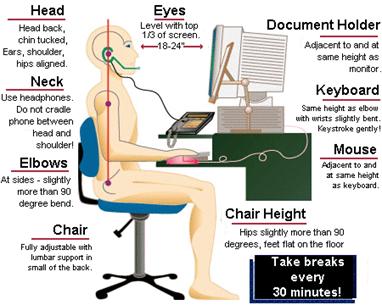
1) In regards to the monitor, the height of the screen is important. The top level of the written text should be at eye level. If it is too low, stack something like old books under it to raise it to eye level. If the monitor is too low, it will cause stiffness in the neck and possibly headaches.
2) The distance between your eyes and the screen should be about an arm’s
length 18-24 inches. Being too close or far away will cause eye strain.
3) If your keyboard is at the proper height, you should be able to type without bending the wrists backwards (dorsiflexion). If your wrists are bent backwards, put a spongy support under the wrists to help keep your wrist neutral. These can be purchased at any office supply store. You can also fold in the little legs that are under the keyboard. This will level out the keyboard and maintain the wrists in a neutral position. If the wrists are kept in an improper position, tendonitis of the forearm or carpel tunnel will likely arise.
4) When using a mouse, be sure your wrist is not angled left or right. This will cause tendonitis or carpal tunnel if done incorrectly.
5) If you are typing while reading from a piece of paper or book that is lying on your desk, do not have it placed too far to the left or right. It should be in an upright position and relatively close to you. When you have your head turned too far one way for a prolonged period of time, the neck will inevitably get sore.
6) Be sure you are using a quality chair. The backrest should give good lumbar
support and be angled 95 to 110 degrees. If the chair has armrests, they should support the elbows lightly. The elbows should be bent at 90 to 110 degrees. The shoulders should be in a comfortable position and hanging loosely, not in a shrug position. Do not let the shoulders roll forward, as this will allow the back to slouch. A good lumbar supports should help correct many of these issues.
7) Never sit for periods longer than 45 minutes. Get up from your seat and go get some water or act like your doing something important. It’s not a good idea to keep the ligaments and tendons it a stretched position for long periods of time.
Try to make these changes to your computer workstation. You will notice a difference immediately and it will help prevent the chronic problems such as tendonitis or carpal tunnel syndrome. Chiropractors are treating many patients with neck, wrist, forearm, shoulder, and upper back problems that are mostly related to how their computer workstations are set up. As I have mentioned before, the best cure for these problems is prevention.
To start with, make these quick changes to get the ball rolling:
1) In regards to the monitor, the height of the screen is important. The top level of the written text should be at eye level. If it is too low, stack something like old books under it to raise it to eye level. If the monitor is too low, it will cause stiffness in the neck and possibly headaches.
2) The distance between your eyes and the screen should be about an arm’s
length 18-24 inches. Being too close or far away will cause eye strain.
3) If your keyboard is at the proper height, you should be able to type without bending the wrists backwards (dorsiflexion). If your wrists are bent backwards, put a spongy support under the wrists to help keep your wrist neutral. These can be purchased at any office supply store. You can also fold in the little legs that are under the keyboard. This will level out the keyboard and maintain the wrists in a neutral position. If the wrists are kept in an improper position, tendonitis of the forearm or carpel tunnel will likely arise.
4) When using a mouse, be sure your wrist is not angled left or right. This will cause tendonitis or carpal tunnel if done incorrectly.
5) If you are typing while reading from a piece of paper or book that is lying on your desk, do not have it placed too far to the left or right. It should be in an upright position and relatively close to you. When you have your head turned too far one way for a prolonged period of time, the neck will inevitably get sore.
6) Be sure you are using a quality chair. The backrest should give good lumbar
support and be angled 95 to 110 degrees. If the chair has armrests, they should support the elbows lightly. The elbows should be bent at 90 to 110 degrees. The shoulders should be in a comfortable position and hanging loosely, not in a shrug position. Do not let the shoulders roll forward, as this will allow the back to slouch. A good lumbar supports should help correct many of these issues.
7) Never sit for periods longer than 45 minutes. Get up from your seat and go get some water or act like your doing something important. It’s not a good idea to keep the ligaments and tendons it a stretched position for long periods of time.
Try to make these changes to your computer workstation. You will notice a difference immediately and it will help prevent the chronic problems such as tendonitis or carpal tunnel syndrome. Chiropractors are treating many patients with neck, wrist, forearm, shoulder, and upper back problems that are mostly related to how their computer workstations are set up. As I have mentioned before, the best cure for these problems is prevention.




 RSS Feed
